How to Crochet for Beginners: What to Buy and What to Learn First
You need one hook, one ball of yarn and two stitches to make your first finished piece. This guide goes through them in the order that makes sense.
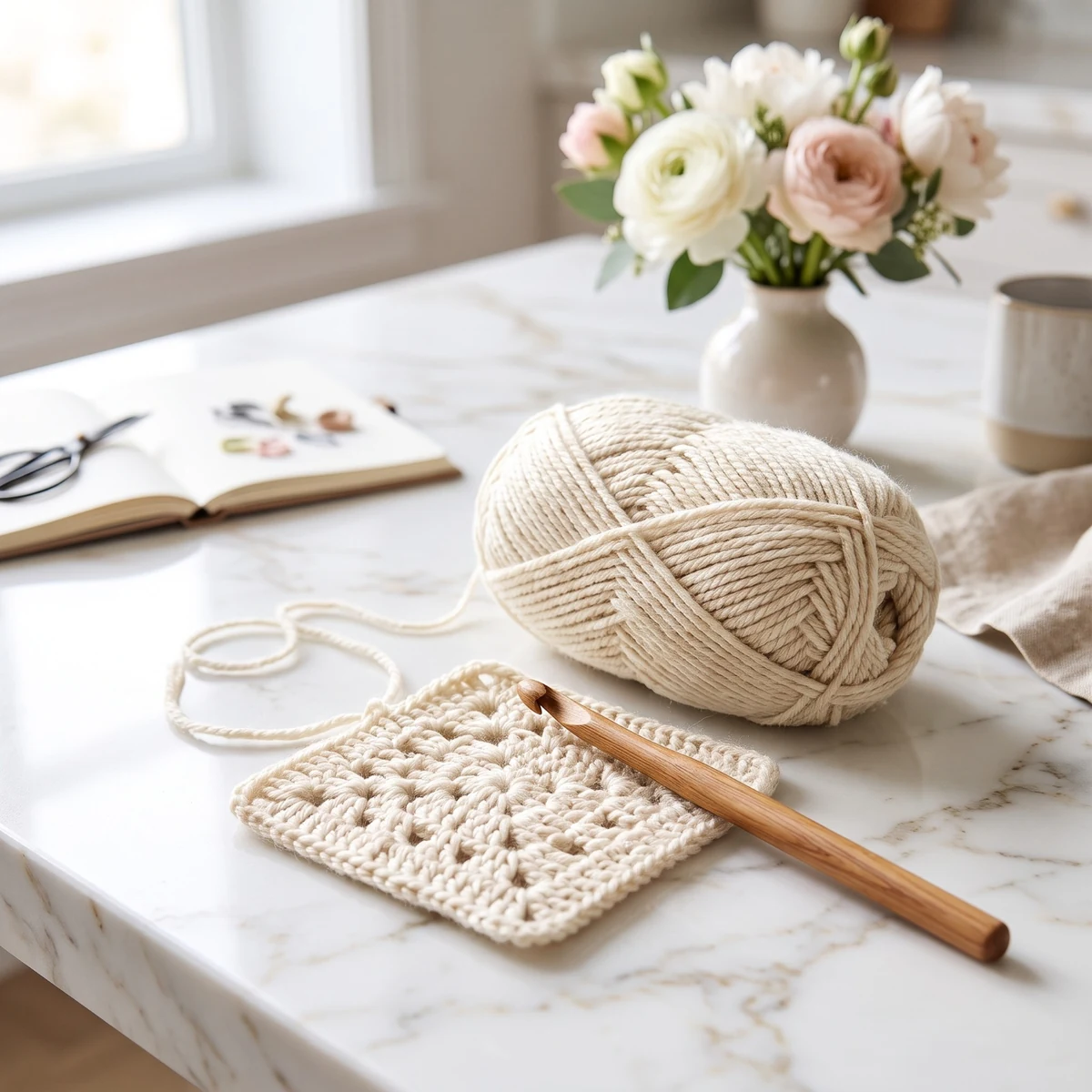
Crochet is a way of making fabric from a single strand of yarn and one hooked tool. You pull loops through other loops, and that's almost the whole craft. Unlike knitting, you only ever have one active loop on the hook, so a mistake is easy to undo and you can't drop a whole row of stitches.
You can get started for very little money, and you need only two stitches to finish your first piece.
What to buy
Keep your first shopping trip small:
- One 5 mm (H-8) hook. A plain aluminum one is fine. See the hook size chart if yours is labeled differently.
- One ball of medium weight (worsted) yarn. The label usually shows a number 4. Pick a smooth, light color.
- Scissors and a tapestry needle. The needle has a large eye and a blunt tip, for sewing in yarn tails.
- A few stitch markers. Safety pins or a loop of contrast yarn work just as well.
Avoid for now: black or navy yarn, fluffy or textured yarn, and very thin yarn with tiny hooks. All of these make it hard to see your stitches, which is the main thing you need to do at this stage.
How to hold the hook and yarn
There are two common grips. Try both, and use whichever is comfortable.
- Pencil grip: hold the hook the way you'd hold a pencil, near the flat part of the handle.
- Knife grip: hold it over the top with your hand, as if you were using a table knife.
Your other hand controls the yarn and holds the work. Let the yarn run between your fingers, and loop it around your pinky or forefinger for a little drag. It will feel clumsy for a while, and that's normal.
Left-handed? The steps are the same, only mirrored. Work from left to right.
Step 1: Make a slip knot
Every project starts here.
- Make a loop in the yarn, with the tail hanging behind it.
- Reach through the loop with your hook, and catch the yarn coming from the ball.
- Pull it through to make a new loop on the hook.
- Pull both ends to tighten the knot, then pull the ball end until the loop sits loosely around the hook.
Step 2: Crochet a chain
The chain (ch) is the base that nearly everything else is worked on.
- Bring the yarn over the hook from back to front. This movement is called a yarn over.
- Pull the yarn through the loop on your hook. That's one chain.
- Repeat, moving your fingers up the chain every few stitches so that you always hold close to the hook.
Make about 20, pull the whole thing out, and do it again until your chains are a similar size. They should be loose enough for your hook to fit back into later. Most beginners chain too tightly.
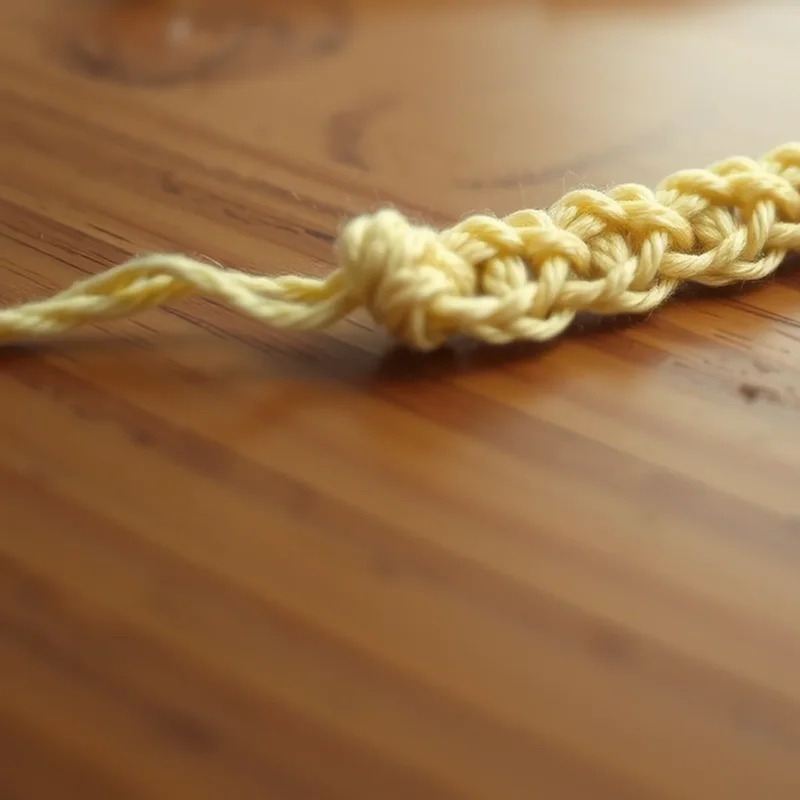
Step 3: Learn single crochet
Single crochet (sc) is short and firm, and it appears in almost every pattern on this site. Our guide on how to single crochet goes through it in detail. In short:
- Insert your hook into the stitch.
- Yarn over and pull up a loop. You now have two loops on the hook.
- Yarn over again and pull through both loops. That's one single crochet.
At the end of a row, chain 1, turn your work over and go back the other way. Skip the chain and put your first stitch in the first real stitch.
Step 4: Make a coaster
Don't start with a blanket. A small square uses everything you've just learned, and you'll have a finished item at the end.
- Chain 16.
- Sc in the 2nd ch from the hook and in each ch across. You should have 15 sc.
- Ch 1 and turn. Sc in each stitch across.
- Repeat step 3 until the piece is square.
- Cut the yarn, leaving a 15 cm tail. Pull it through the final loop to fasten off.
- Weave in the ends with your needle.
Count your stitches at the end of every row. If you've got fewer than 15, you've probably missed the last stitch. This is the most common beginner problem, and our list of common crochet mistakes has the fix.
What to learn next
There's no need to learn it all at once. A good order is:
- Half double crochet: a slightly taller stitch that grows more quickly
- Double crochet: the tall stitch behind most blankets and granny squares
- How to read a pattern: so abbreviations like "sc" and "ch" start making sense
- US and UK terms: so that a pattern from elsewhere doesn't catch you out
- The magic ring: the start of hats, circles and toys
Good first projects
- A set of coasters: same pattern, more practice
- An easy scarf: only chains and single crochet, in a stitch that looks a lot harder than it is
- An easy Christmas ornament: a small piece that's nice to finish and easy to give away
Want more choice? We've sorted 20 things to crochet by how much time they take.
Frequently asked questions
Is crochet hard to learn?
The movements are simple, but your hands take a while to get used to them. Most of the difficulty is in the first few sessions, especially in keeping an even tension. Short, frequent practice works better than one long session.
How long does it take to learn?
Many people can make a chain and a row of stitches in their first sitting, and can finish a simple coaster within a few sessions. Learning to work from patterns comes later, and at your own pace.
Is crochet easier than knitting?
It's a matter of opinion, but crochet has an advantage for beginners: one hook and one active loop. If you make a mistake, just pull the yarn back to it and carry on.
What is the difference between crochet and knitting?
Crochet uses one hook and completes each stitch before moving on to the next. Knitting uses two needles and keeps a whole row of open loops on the needle.
Crochet Christmas Ornament Set – 10 Amigurumi Patterns – Digital crochet pattern (PDF)