How to Double Crochet (dc) and Decrease With dc2tog
The tall, fast stitch behind most blankets and granny squares. Learn the stitch, the turning chain that trips people up and how to decrease.
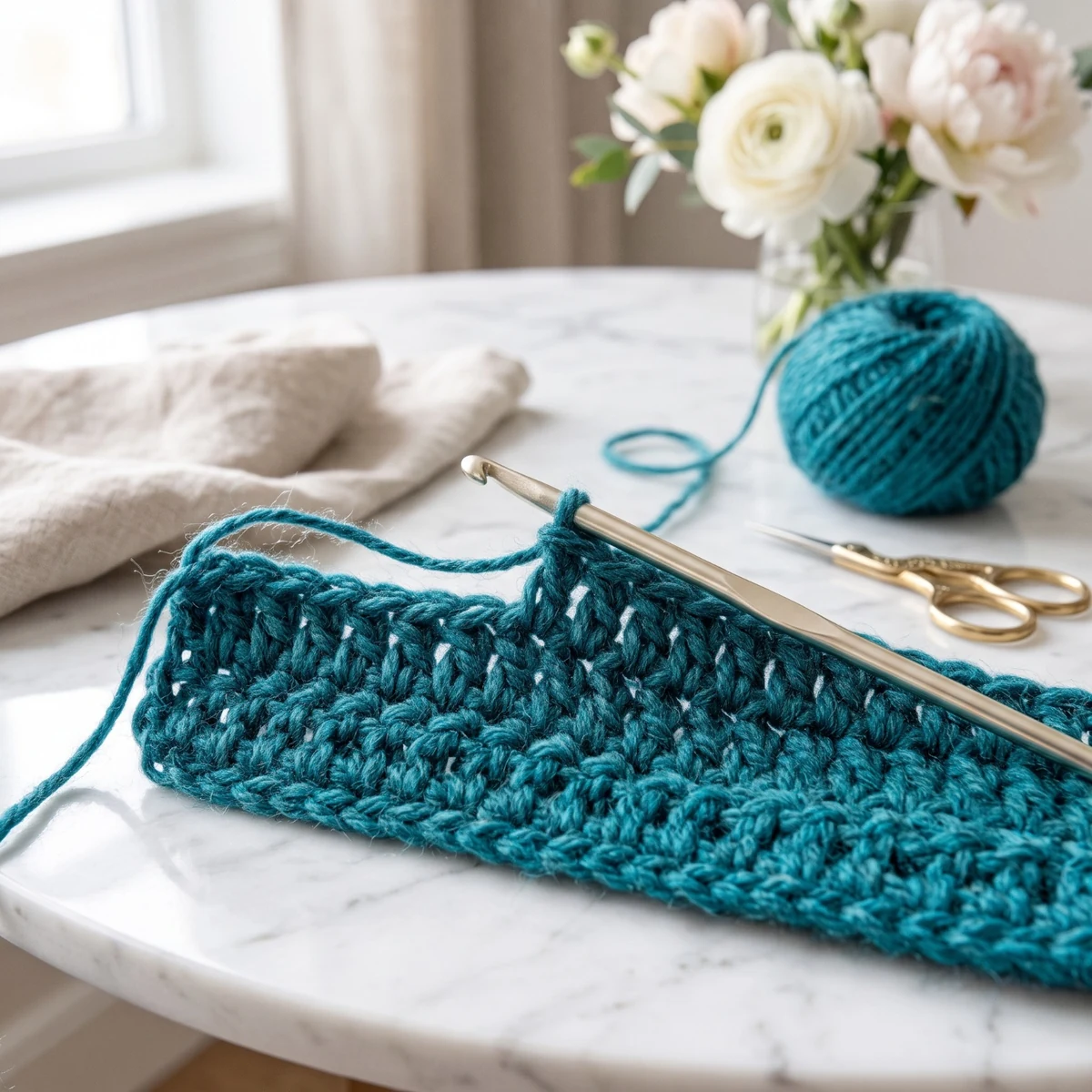
Double crochet (dc) is about twice as tall as single crochet, which means that your work grows about twice as fast. It's the stitch behind most blankets, granny squares and shawls. The movement is simple, and the part most people find tricky is actually the turning chain at the start of each row.
A note on names: this is the US term. The same stitch is called a treble (tr) in the UK and Australia. A "UK double crochet" is what Americans call a single crochet. If you aren't sure which your pattern uses, see our US and UK terms chart.
How to double crochet
Begin with a loop on your hook, and follow these steps:
- Yarn over. You have 2 loops on the hook.
- Insert your hook into the stitch, then yarn over.
- Pull up a loop. You now have 3 loops on the hook.
- Yarn over and pull through 2 loops. You have 2 loops left.
- Yarn over and pull through the last 2 loops. You have 1 loop left, and that's a finished stitch.
The way to remember it: yarn over, in, pull up, then through two, through two. Many people say it out loud for the first few rows.
Practice swatch
Foundation: ch 17.
Row 1: dc in the 4th ch from the hook. The first 3 chains you skipped count as your first stitch. Dc in each remaining ch across. You should have 15 stitches, including the chain.
Row 2: ch 3 and turn. This chain counts as your first stitch, so skip the very first stitch below it. Dc in each stitch across. Your last dc goes into the top of the turning chain from the row before. (15 stitches)
All other rows: repeat Row 2. Make about 10 rows, then count your stitches.
The turning chain, explained
Double crochet needs a chain of 3 at the start of a row to bring the yarn up to the right height. There are two common ways of handling it, and patterns should tell you which one they're using.
- Ch 3 counts as a stitch (the traditional way). Skip the first stitch and work into the next. At the other end, work the last dc into the top chain of the turning chain.
- Ch 2 doesn't count as a stitch (a common modern way). Work the first dc into the very first stitch. Skip the turning chain at the other end.
Neither is wrong, but don't mix them. Mixing them is the reason many beginners end up with a piece that gets wider or narrower. Our list of common crochet mistakes goes over this and more.
Where to put your hook
Unless your pattern says otherwise, you go under both loops of the V at the top of each stitch. Three other places you might see in patterns:
- Back loop only (BLO): makes a stretchy ridge, as used in our crochet beanie.
- In a space: you go into the gap under a chain, as you do in a granny square.
- Around the post (FPdc): you go around the body of the stitch, as you do in waffle stitch.
How to decrease: dc2tog
A dc2tog turns 2 stitches into 1. It's a double crochet decrease, and you'll see it often in garments, hats and shaped pieces. The idea is to make two unfinished double crochets, then join them at the top.
- Yarn over and insert your hook into the next stitch.
- Yarn over and pull up a loop. You have 3 loops on the hook.
- Yarn over and pull through 2 loops. You have 2 loops on the hook.
- Yarn over and insert your hook into the following stitch.
- Yarn over and pull up a loop. You have 4 loops on the hook.
- Yarn over and pull through 2 loops. You have 3 loops on the hook.
- Yarn over and pull through all 3 loops.
You've now used 2 stitches below, but you've made just 1 stitch on top, so your stitch count drops by one.
How to increase
This one is easy. Work 2 dc in the same stitch. Your count goes up by one. For a neat edge, increase a stitch or two in from the end of the row, rather than in the very first stitch.
Common problems
- Stitches look loose or gappy. Try a smaller hook. Dc is a more open stitch than sc, and that's normal, but it shouldn't look like mesh.
- Stitches look short. You may be pulling the first loop too tight. Pull it up to about the height of the turning chain.
- There are holes along the sides. These often come from the ch 3 turning chain, particularly when it's long. Try ch 2, working the first dc in the first stitch.
- Your fabric slants. Check that you're working the last stitch into the top of the turning chain, as it's the easiest stitch to miss.
What to make with double crochet
- A quick blanket, since tall stitches finish faster
- A classic granny square
- The lemon peel stitch, which alternates dc with sc
Frequently asked questions
What does dc mean in crochet?
It stands for double crochet. In a US pattern, it's the tall stitch described above. In a UK pattern, dc means the shorter stitch known in the US as single crochet.
What's dc2tog in crochet?
It's short for "double crochet 2 together", a way of decreasing by one stitch.
How is it different from half double crochet?
In a half double crochet, you yarn over, pull up a loop, yarn over again and pull through all 3 loops at once. It's shorter and denser. In double crochet, you pull through 2 loops, twice, which makes it taller.
How many chains do I need to begin?
Chain the number of stitches you want, then add 2 more. So, for 15 double crochets, chain 17. The first 3 chains count as your first dc.
Granny Square Tote Bag, Market Bag & Round Bag Crochet Patterns – Digital crochet pattern (PDF)